What 55,000 tweets tell us about how the Dutch talk about cancer screening
Cancer screening catches disease early, when it's easier to treat, and yet fewer people are showing up for it. In the Netherlands, cervical screening uptake sits well below the 70% threshold the World Health Organization says a program needs to actually reduce cancer deaths at a population level. People increasingly turn to the internet, including social media, to help decide whether to take part. So we asked a straightforward question: what does that conversation actually look like on Twitter/X?
We pulled every Dutch-language tweet mentioning cancer screening between 2011 and March 2023 from an archive of 5.9 billion tweets, 55,403 of them in total, posted by 22,493 users. We wanted to know three things: how much people were tweeting about screening and when, what they linked to, and how much of what they said was actually wrong.
How much people tweet, and when
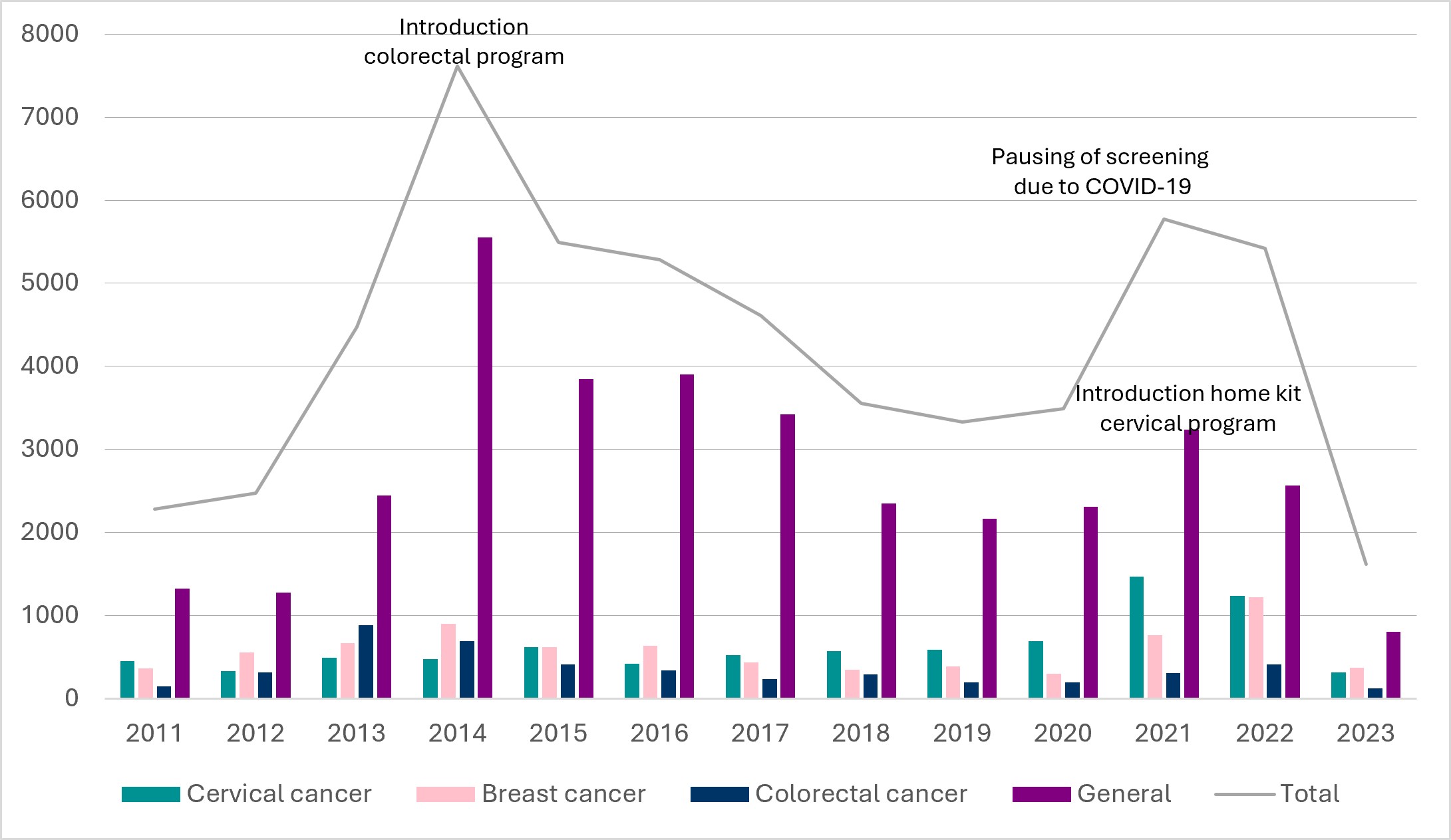
Tweets about screening weren't spread evenly across the twelve years or the four programs we tracked (general population screening, and the specific breast, cervical, and colorectal programs). Most tweets, nearly two-thirds of the corpus, talked about screening in general rather than any one program.
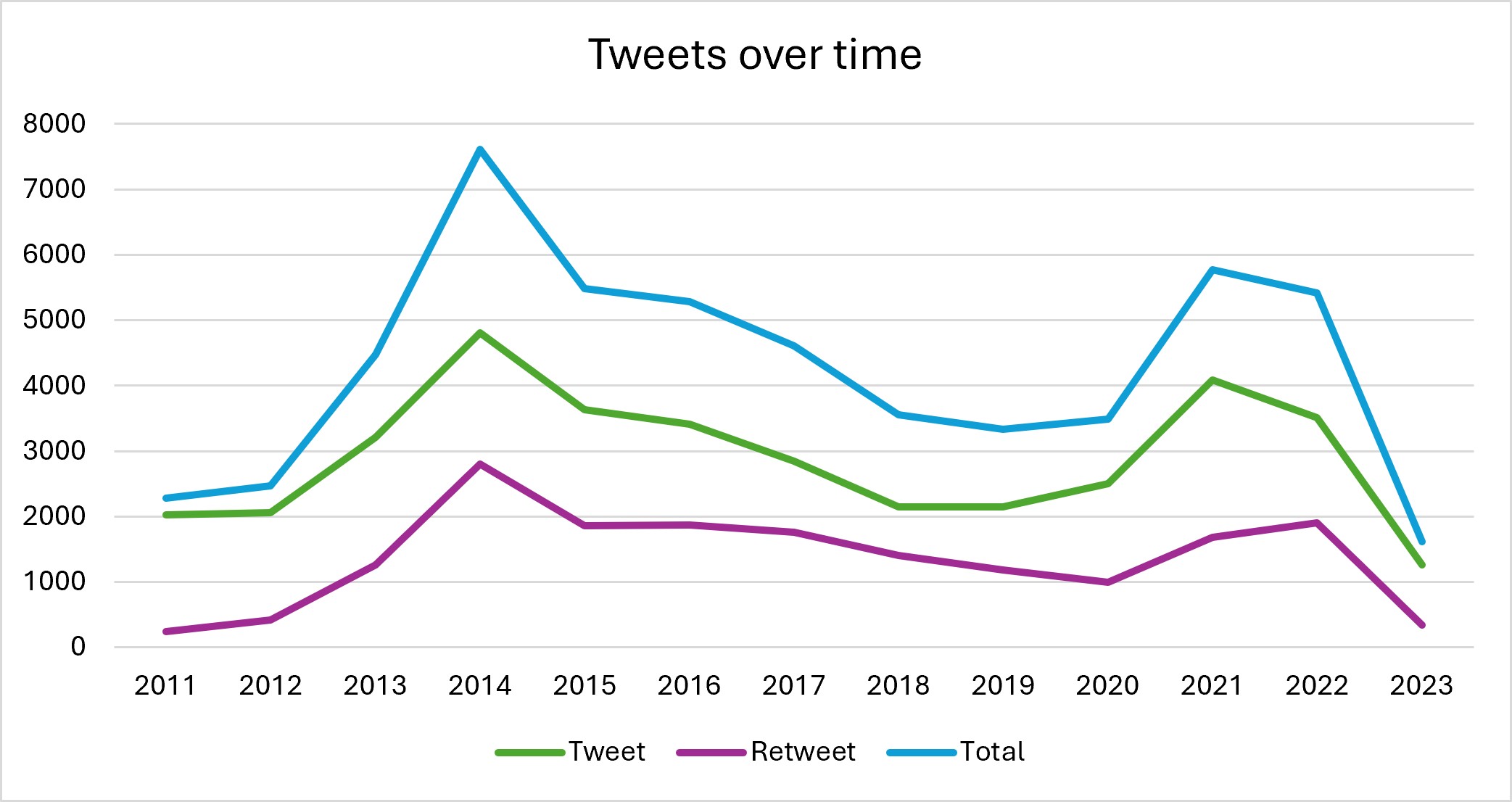
A third of the tweets, 32%, were retweets rather than original posts, and another 19% were replies to someone else. That mix of original posts, replies, and retweets suggests screening wasn't just something people posted about in isolation; it was something they talked back and forth about.
Two moments stand out. The first is 2014, when the colorectal screening program launched in the Netherlands; tweet volume about colorectal screening, and about screening in general, spiked well above what we'd expect from an ordinary year. The second is 2021, tied to two things happening close together: the pandemic-era pause of the national screening programs, and the rollout of a home test kit for cervical screening. Tweets about cervical screening rose noticeably that year. Both moments point to the same pattern: people tweet about screening when something changes in the real world, not at a steady background rate.
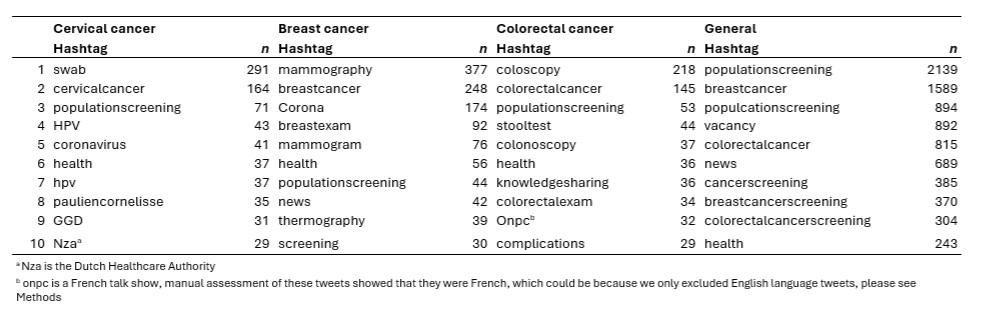
We also looked at hashtags. About a third of tweets used at least one. The tags people reached for mostly named the thing being discussed, "breastcancer," "populationscreening," "colorectal cancer," rather than anything more editorial. That held up when we broke hashtags down by program.
What people link to
Just under half of all tweets carried a link, and here's the finding we didn't expect: the single most common thing people linked to was another tweet. Actual news sites came next, led by a major Dutch publisher, then the national broadcaster NOS, a Dutch news aggregator, and the website of the Dutch Journal of Healthcare (Nederlands Tijdschrift voor Geneeskunde). The website of the RIVM, the government body that runs the Dutch screening programs, showed up too, but far down the list: tenth place, cited in only 343 of 23,579 linked tweets.
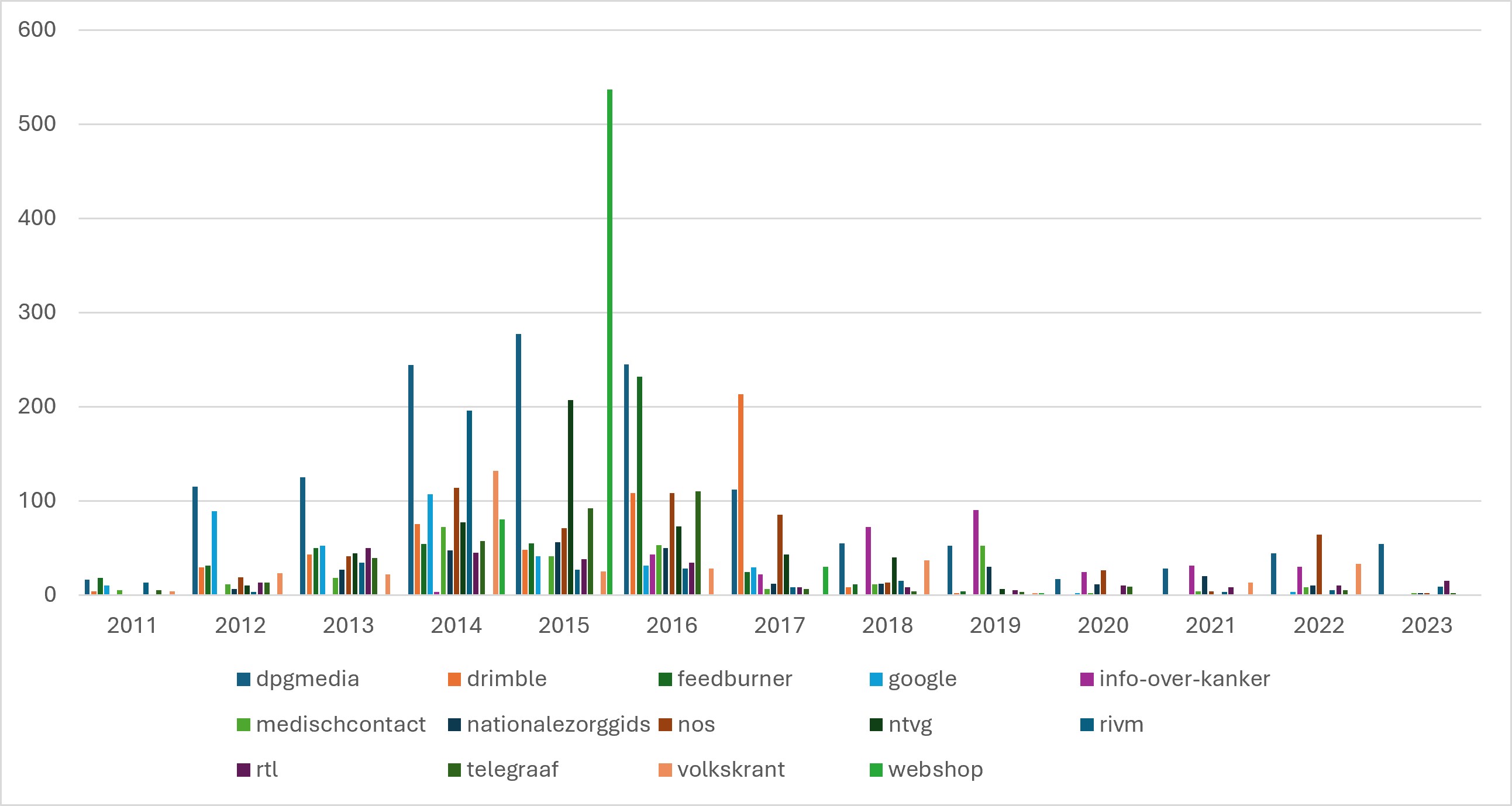
One particular spike is worth mentioning on its own. In 2015, links to the Dutch Journal of Healthcare's website surged, driven by tweets debating a research paper on colorectal screening, a rebuttal to it, and a follow-up interview the journal ran on the benefits and risks of the program. That single back-and-forth generated more retweets than almost anything else in that category, which tells us something about how a single piece of published research can seed weeks of public debate on the platform.
So contrary to a common worry, that social media crowds out official, evidence-based sources with grassroots or unreliable ones, we didn't find alternative-medicine or fringe websites among the most-shared links. The caution is that we couldn't see inside the tweets people linked to, since our dataset didn't include the content of those linked posts, so misinformation could still be circulating one layer deeper than we could measure.
How much misinformation, and what kind
This is the part most people ask about first, so here are the numbers straight. We manually checked a representative sample of 1,200 tweets, weighted to match the full dataset by year and program. Of those, 924 were actually about the Dutch screening programs, and 679 of those shared some kind of factual claim rather than just a personal story or opinion. Out of that group, 23 tweets, about 3.4%, contained a claim we classified as misinformation.
That's a much lower rate than has been reported for cancer content on social media elsewhere; one earlier study found misinformation in 44% of the most-liked cancer-related posts on social media. It's worth being precise about what we did and didn't count as misinformation here. There's genuine, ongoing scientific disagreement about breast cancer screening specifically, about overdiagnosis, about how large the mortality benefit really is, about whether the costs are worth it. We didn't count someone repeating that debate as misinformation. What we did count were claims stated as settled fact with no evidence behind them: that screening flatly doesn't save lives, that pausing the program during COVID-19 caused large numbers of deaths, that more mammograms directly cause more cancer or more amputations.
The 23 misinformation tweets split fairly evenly across programs: eight about general population screening, eight about breast screening, four about cervical screening, three about colorectal screening. The flavor of the claims differed by program. General and breast screening misinformation leaned toward flat assertions of ineffectiveness and vague suspicion of pharmaceutical industry motives. Cervical screening misinformation involved distrust of the HPV vaccine, plus one case that ran the other way: a tweet overstating how much more frequent screening reduces deaths, which is misinformation in favor of screening rather than against it. Colorectal screening misinformation centered on claimed harms from the procedure itself, again without evidence.
Across all of these, the tone mattered as much as the content. Most misinformation tweets used rhetorical questions, sarcasm, open anger, or fear-based language, rather than a neutral statement of a wrong fact.
We want to be careful not to overstate what a 3.4% rate means. The sample of misinformation tweets is small, 23 tweets, so we can't draw firm conclusions about differences between programs or trends over time. And we'd echo a point that's easy to lose in a headline statistic: a low rate doesn't mean the risk is low. Prior research has found that tweets built around misinformation tend to use more emotionally engaging language and more personal pronouns than accurate tweets do, which means a small number of misleading posts can travel further than their raw count suggests. Rare doesn't mean harmless.
What this adds up to
Put together, these three findings show a fairly specific picture of Twitter/X as a space for talking about cancer screening. Conversation clusters around real events, program launches, pandemic disruptions, new tools like the home test kit, rather than running at a constant hum. When people share sources, official government information barely registers next to news coverage and, more than anything, other tweets. And outright misinformation is present but rare, concentrated less in wholesale fabrication and more in confident, evidence-free extensions of a real and ongoing scientific debate.
For anyone involved in public health communication, we think the practical read is this: the moments when screening programs change, a pause, a new test, a policy shift, are exactly when public attention spikes on social media, which makes them the highest-value windows for putting accurate information directly into that conversation rather than after the fact.
It's also worth pointing out what this study doesn't show. We looked at one platform over twelve years, and we can't say how representative Dutch Twitter/X conversations are of what people actually think or do about screening more broadly, plenty of relevant conversation happens on platforms we didn't touch, or off social media entirely. What we can say is that within this dataset, the volume of talk tracked real-world screening news closely enough that social media looks like a genuine, if partial, window onto how a population responds when a screening program changes.
Paper
The Twitter paper can be found here.